
Down The Rabbit Hole
I used to think inspiration arrived fully formed, like a parcel from the universe, dropped at the door. What actually shows up are fragments. A phrase that lingers. An image that won’t leave. A sense that something important is nearby, but not yet willing to reveal itself.
I’ve put a lot of projects down over the years. Unfinished things can’t fail. But sometimes, when I stepped away, the work kept moving without me, rearranging itself while I wasn’t watching. I understand now that learning what can wait, and listening for what can’t is a part of the process. Some things need time, not as delay, but as an ingredient.
When the words or the tasks won’t leave me alone, when my mind needs fresh air, I pick up a brush. Moving pigment across a canvas softens the urgency of my competing thoughts. Meditation for the restless. For those of us living with seventeen brain browsers open. A way to force the system to idle so the update can finish.
Last night, the browsers were particularly loud, so I started what I’ve come to call procrastipainting. I’d flirted with oils but this time I committed. I followed the sharp, silent impulse to let the task leave me alone. The tiles of my living room now carry the evidence.
Somewhere between the reds and the beige of my canvas, I thought of my Nan. Her humour. Her hands. How she told me you heal by using them. How she was always painting. Her pragmatism.
I wondered if any of her art was on the internet, just to see it again. I once tried to explain the internet to her. She said, “I was born in 1916 love. I’ve seen the invention of the telephone. The television. I watched man land on the moon. We were the first family in Ipswich to own a motorcar. I’m too old to worry about this internet thing. I’ve seen many a new thing.”
Still, it was worth a try. I stumbled onto a writing blog. It belonged to my aunty, Monya Mary Clayton. It held what I’d hoped for and also much more.
I was mesmerised by her elegant ambling style. I read her words into the early hours. Then again when I woke. She wrote about my Nan’s art, how she didn’t begin painting until she was sixty-two. How she never thought of herself as an artist, until someone who couldn’t classify her work told her, “Just go home and paint.” And she did.
Her work now sits in the Queensland University Library, in archives kept to preserve our country’s cultural legacy. It’s described as temporal surrealism. Old towns. Small figures. Horses. Landscapes where multiple moments exist at once. Scale bent. Past and present sharing the same frame. She created the world as she felt it, not as it was seen.
Reading Monya’s words, I recognised the same weight my mother insisted on when she sat beside me drilling spelling, grammar and pronunciation. I rebelled, I complained endlessly. She never stopped. This discovery felt like being handed the family syllabus, the apprenticeship I didn’t know I’d been signed for. I asked Mum for her number.
The voice on the other end was immediate and familiar.
“Hello Aunty Monya, it’s Elly.”
“Oh hello, love. How are you?”
As if thirty years hadn’t passed.
We talked about writing. I told her she spoke exactly as she wrote. She said I must practise arriving at my sentences, not discovering them, that writing becomes easier when you inhabit your voice verbally. She spoke with the authority of someone who has learned how to make meaning out of anything.
We spoke of eight year old me. The class had been asked to write about a lost dog. Most children wrote about the dog wandering off, being found and happy endings. I wrote about the waiting. The thirst. What it might feel like to eat again. The relief, the smiles when the dog returned.
“I can imagine the divide between your perception of the world and that of others feels terribly wide at times,” she said.
I wrote that down, because of the way it squirmed in my heart.
It had been days traversing this rabbit hole painting, reading, listening, when I tripped over the thread that had been running beneath my life. I finally had the sense to pull it.
Now I understand the need to excavate, document and share a temporal view that holds time long enough to outlast its moment. It’s an inherited impulse that I’m translating into my own era, with better tools and less sleep.
I reconnected to the source.
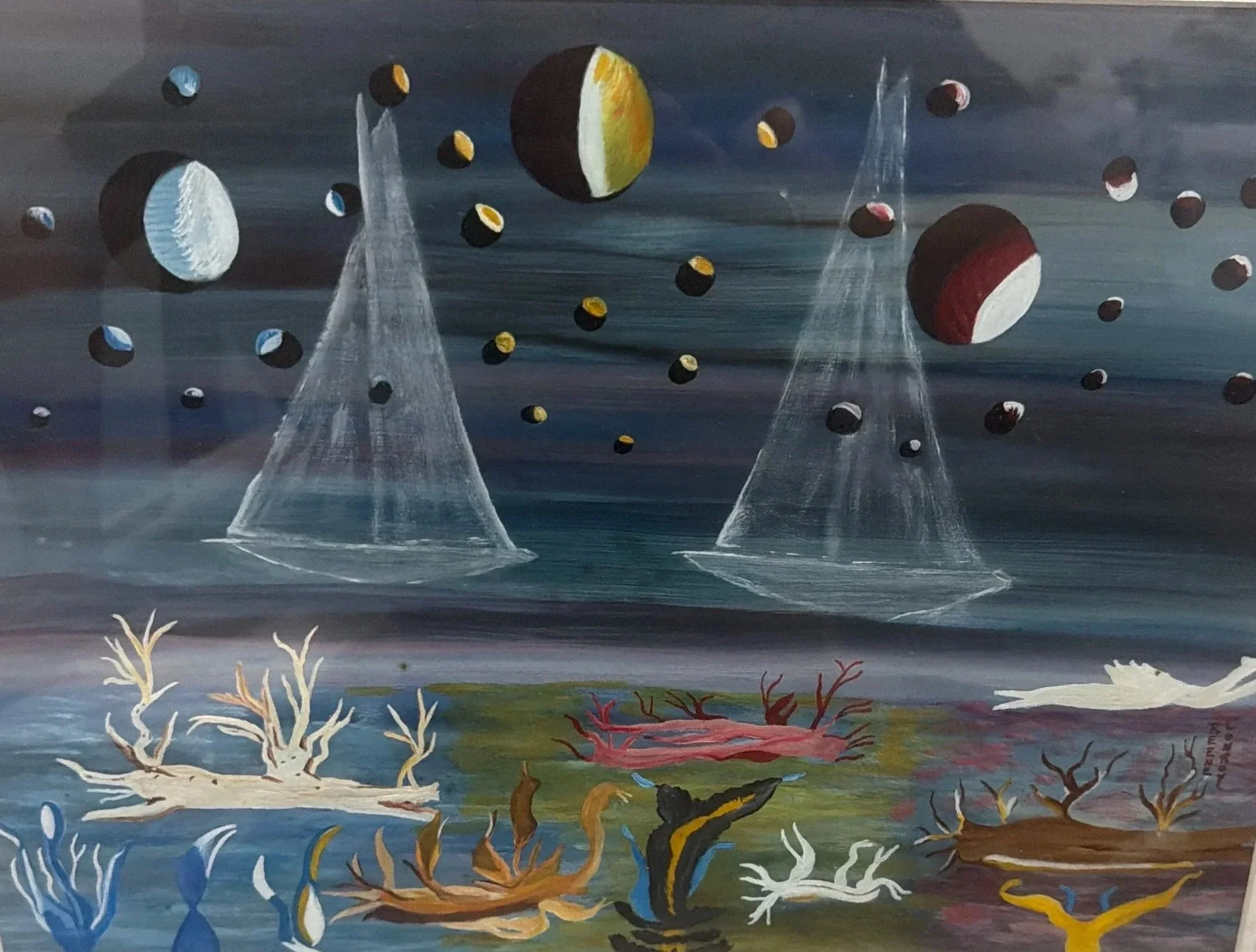
“Moon Drift” by Reené Conroy